Sample Preparation
Sample preparation for NanoSIMS experiments is crucial in order to get reliable results. Sample preparation needs to be tailored to each particular sample and it is important to contact us prior to your experiment to discuss this.
Below are some general sample requirements to help you prepare your samples and determine if your sample is suitable for NanoSIMS analysis.
General Sample Requirements:
- The sample must be stable under vacuum and not outgas (the analysis chamber is at 10-10 mbar, much higher than a typical SEM)
- The sample should be loaded into the vacuum system ideally 1 week before the session
- The sample surface must be flat as topography will artificially enhance signals at edges
- The sample should not have any loose pieces
- If the sample is non-conducting it will be necessary to coat the sample with a thin layer of platinum (this is best done in the NanoSIMS lab just prior to sample loading)
Sample Holders:
We have 3 sample holder configurations:
Biology – 8 x 10 mm diameter apertures
Geology – 1 x 25 mm, 2 x 13 mm, 2 x 10 mm diameter apertures
Harvard – for 5×5 mm silicon wafers
We also have a holder for TEM grids which fits into the 10 mm aperture
Sample Size:
- The maximum thickness of sample that can fit into the sample holder is 5 mm (4 mm is the ideal thickness). Thinner samples can be loaded, e.g. Si wafers.
- If using the biology holder, a cylindrical sample must have a diameter between 10 and 10.2 mm.
- If using the biology holder, for a rectangular or square sample the diagonals must be 10 mm, this equates to a 7.2 x 7.2 mm square sample.
- Irregularly shaped or small samples should be embedded in resin (fully cured) or wood’s metal, and the mounting medium must be cut down to the correct size as above. It will probably be necessary to polish back down to the surface of interest. We have 10 mm diameter embedding rings to help with sizing.
- Samples are mounted with respect to the front of the sample holder so cannot be simply stuck to a metal cylinder as they will protrude from the front and scratch the lens.
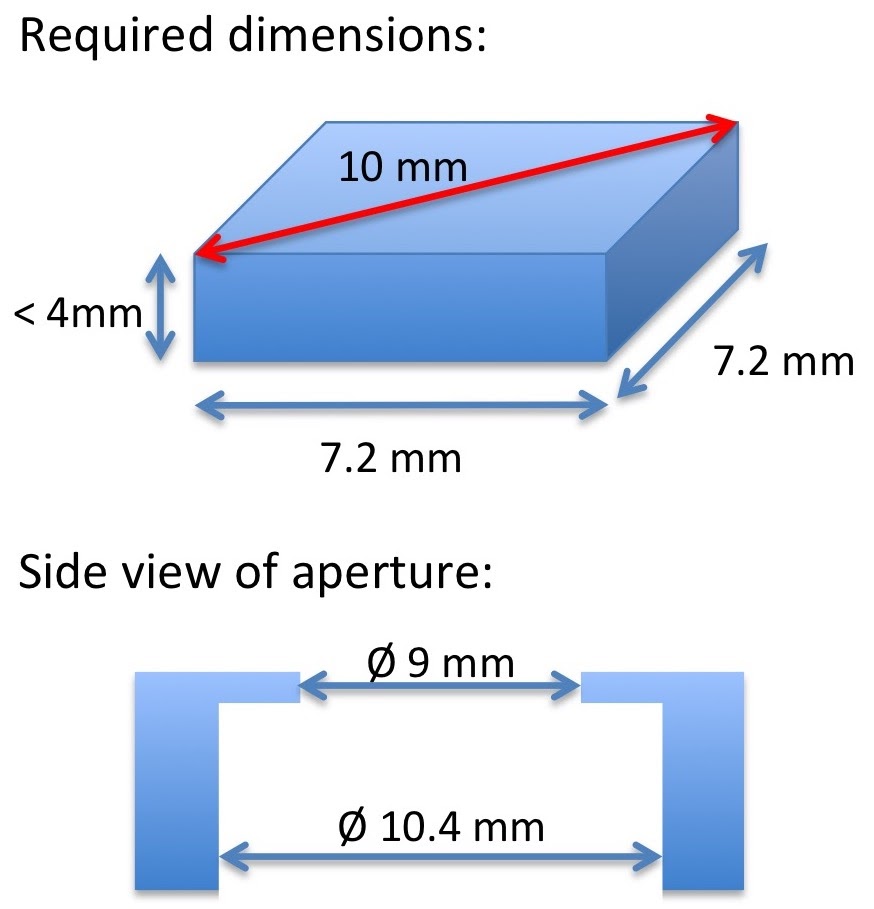
Other experimental considerations:
A maximum of 8 samples (for a biology holder) or 5 for a (geology holder) can be loaded at the same time therefore minimising pumping and sample exchange time. Having more than one replicate on a stub will help fit more samples onto the holder.
- If the analysis involves the detection of trace or uncommon elements, standards of high concentration must be provided. If many standards are required they should all be mounted together so that they only take up one position on the sample holder (sample size restrictions still apply). The NanoSIMS group has some standards already prepared which may be applicable.
- The field of view of the optical camera on the NanoSIMS is limited so it is necessary to have an optical or SEM map of the whole sample at reasonable magnification. The areas of interest should be marked (for example with indentations). The field of view of the optical camera is approximately 400 µm by 300 µm.
Surface finish for metals:
- Samples (cut or embedded) must be highly polished. Samples should not be bevelled, sloping or rounded at the edges.
- Quality of polish as for EBSD (minimum 1 μm diamond, colloidal silica/OPS preferred)
- Do not etch the sample (some OPS etching is ok)
- If features of interest/alignment marks are required use nano/micro-indentation
Sample cleanliness for metal/solid samples:
- After polishing, sample must be cleaned in ultrasonic bath with distilled water for 10 minutes
- Then clean in an ultrasonic bath with isopropanol for 10-15 minutes
- Dry the sample ensuring there are no solvent stains and no dust/fibres on it
- After cleaning only handle the sample with tweezers or gloves
- Store in a clean sample box, do not stick it to the box with any form of tape